

Sprinkle Texas
South East of Pioneer farms in Northeast Austin there once was a little town called Sprinkle Texas.
William Sprinkle came to Texas and became a cowboy herding cattle along the Chisholm trial. It was on that trail where he discovered the rich soil and abundant live oaks along Walnut Creek. He decided that was where he would buy 223 acres and settle. William invited his uncle Eramus who’s wife had just past away in Virginia to move to Texas. Eramus had three daughters one was widowed during the Civil War and making a living as a school teacher. Cremora and her four children immigrated with him.
For more information about Eramus ckick here.
The town of Sprinkle began it’s slow decline into oblivion as many small towns in rural Texas did following the demise of the cotton industry and the depression. Today the only remaining building in the real town of Sprinkle is the Barr Mansion.
Click here to learn more about the mansion.
There was also an African American community in Sprinkle including a school. According to the TSHA:
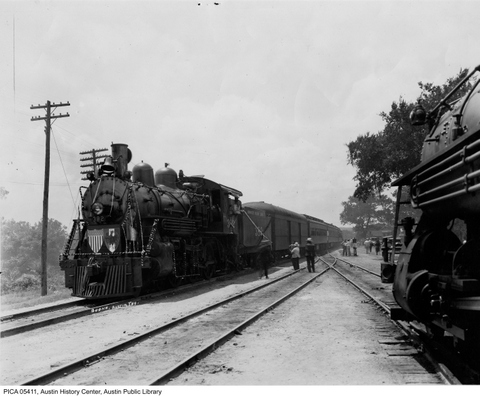
“The post office at Sprinkle closed in 1902, and for a time mail for the community was sent to Manor. In 1904, however, the Missouri, Kansas and Texas Railroad was built through the town, and the post office at Sprinkle reopened. The railroad helped residents at first, but the population continued to decline, falling to fifty by 1914 and to ten by the early 1930s. Around 1900 Sprinkle was the focus of a common school district that had one school for sixty White students and one for forty-seven Black students. In the late 1930s these schools were consolidated with the Manor Independent School District. Improvements in roads and the availability of automobiles encouraged the few remaining residents to take their business to nearby Austin instead of to local establishments. ”
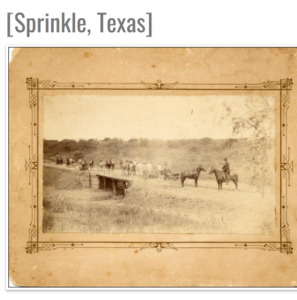
Picture from Portal to Texas History
When the 90 acre outdoor living history museum Pioneer Farms was created it called the collection of relocated buildings that were placed in a circle the town of Sprinkle in memory of the forgotten town.
The other remaining building that is all that is left of Sprinkle Texas is one of the buildings on the town square the Jarmon House (or Jamison) This one-story frame house was built around 1900 by Robert Jarmon, a Kentuckian who came to Texas in 1874 and eventually landed in the tiny community of Sprinkle. Jarmon began clerking in the Sprinkle store, by 1890 was the manager and, by 1897, was an owner. He and his wife Beulah, close friends with the wealthy W.T. Barr family whose Victorian mansion was an area landmark, reared six children and became prominent residents. Their house, built atop a hill, was moved to Pioneer Farms in 2010 to save it from demolition.
Today the ghosts in this house are in an ongoing state of confusion. When the house was moved they set it on the square but when they did it was placed facing a different direction than it had when it was built on the hill in Sprinkle. When the sun and moon rise and fall they cast light in through the windows from a different direction confusing the ghosts inside.
Butterfield Overland Trail (Mail Company) – a consortium of four “Pony Express” companies: Adams, American, National, and Wells, Fargo – signed a six-year contract with the U.S. government on September 15, 1857. The Butterfield (or Oxbow) Route went from St. Louis, Missouri, through El Paso, then west to Los Angeles. Most of the Butterfield Overland Mail line would be disrupted and destroyed by Confederate troops during the Civil War.
Chisholm Trail – Originating south of San Antonio, Texas, the trail ran north across Oklahoma, and ended in Kansas. Between 1867 and 1871 about 1.5 million head of cattle were driven north along the trail. The trail’s importance declined after 1871, as railheads were established.
El Camino Real – “Royal Road”. During the Spanish colonial period in North America, a collection of indigenous trails and trade routes became known as El Camino Real de los Tejas, the primary overland route for the Spanish colonization. Soldiers used the trail during the Mexican Independence and the Texas Revolution conflicts. The use of the trail diminished after Texas became a state in 1848.
Goodnight-Loving Trail – The trail ran southwest to connect with the Pecos River and thence up the river valley through New Mexico and north to the railhead at Denver, Colorado. The trail was established in 1866 by cattlemen Charles Goodnight and Oliver Loving, who followed a route of the Butterfield Overland Mail. The arrival of the railroads to western Texas in the early 1880s made the long cattle drives unnecessary. The trail’s role in Texas history is celebrated in Larry McMurtry’s 1985 novel Lonesome Dove.
Potter-Blocker Trail – In the spring of 1883, Alfred T. Bacon, manager of the New England Livestock Company, purchased a herd of 3,000 Mexican cattle for delivery at Cheyenne, Wyoming. He received the herd at Peña Station, near Hebbronville, Texas, and hired Jack Potter to trail them north. Following the Western Trail, he received word to leave the Western and try a cutoff that might save some twenty days’ trailing time. Abner P. Blocker used part of the same trail after 1885 to move cattle from the south into the sprawling XIT Ranch, hence the later designation of Potter-Blocker Trail.
Shawnee Trail – Used before and just after the Civil War, the Shawnee Trail gathered cattle from east and west of its main stem, which passed through Austin, Waco, and Dallas. The drovers took over a trail long used by Indians in hunting and raiding and by southbound settlers from the Midwest; the latter called it the Texas Road.
Western Trail – The Western Trail, also known as the Great Western Trail, Dodge City Trail, and the Fort Griffin Trail, was blazed in 1874 by cattle-drover John T. Lytle, who herded 3,500 longhorn cattle along the leading edge of the frontier from South Texas to Nebraska. Lytle’s route supplanted the farmer-laden Chisholm Trail to the east. By 1879 the Western Trail was the principal thoroughfare for Texas cattle bound for northern markets.
To join our ghost tour at Pioneer Farms click here.
Written by Jeanine Plumer
© Copyright 2026, Austin Ghost Tours. All Rights Reserved.
What is up there with haunted railroad crossings in Texas? Haunted bridges. Each is of course, the MOST haunted.
Shine a light
According to radio 600 am in El Paso states it is the Maxdale bridge in Killeen, Texas. Was it a school bus full of children that all died when the bridge collapsed? The other story is that a man’s girlfriend drowned in the river below the bridge while going for a swim. Unable to save her, the man was so distraught over the loss of his love that he hung himself from the bridge not long after her death. At night if you shine your headlights, you can see the silhouette of the man hanging from the bridge.
Goatman’s Bridge
Also haunted, Goatman’s Bridge in Denton. “legend says a group of Klansmen murdered a beloved black goat farmer on Old Alton Bridge in 1938. The black goat farmer was endearingly called Goatman by residents of Denton. The Klansmen crossed the bridge with their headlights off and lynched the Goatman off the side of the bridge. Eventually, the Klansmen decided to go back and kill the Goatman’s family.
Shine a light
The Goatman’s spirit lingers in the woods surrounding the bridge and those who turn off their headlights while crossing the bridge will see the Goatman on the other side. I put this test to theory myself and attempted the urban legend with a friend of mine on a Friday night. Besides a chill going through our bodies at the possibility of seeing the Goatman on the other side of the bridge, we ultimately saw nothing. However, you can go at your own risk. Maybe you’ll find the Goatman on the other side.
Devil’s Bridge San Antonio – True evil is believed to lurk on this bridge at night. You may even smell sulfur (rotten eggs), which is usually a sign that something demonic is lingering around, waiting. It is also said that if you dare to step up to foot of the bridge and throw a rock, you’ll never hear it land. It’s almost as if someone (or something) catches the rock, or possibly, the rock disappears all together.
Shine a light
It’s been said that after night fall, the darkness that surrounds the bridge is so dense, that if you shine a light it will not penetrate more than a few feet out. So, be careful if you actually decide to drive over the bridge at night.
To read the truth about Texas Bridges read Jon McConal’s excellent book click here
To read more about haunted Texas locations click here
MORE Original Austin Ghost Tours
Tour guide Monica was talking to a HEB employee at her regular HEB who knew she worked with Austin Ghost Tours. He told her this story:
“I notice shoes,” Elroy, my bagger at the local H.E.B. told me the Saturday before Halloween. “So when I was in the men’s room at The Speakeasy in downtown Austin, I couldn’t help but notice the guy’s shoes in the reflection of the mirror as I washed up. They were all I could see under the door, you understand, but they were really nice boots.
And a moment after that, from inside the bar, a woman screamed! It wasn’t until then that it hit me what I had seen!”