

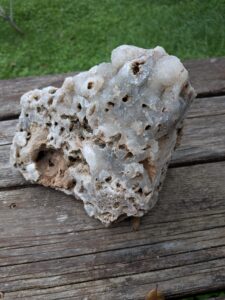
Fort Mason, is located in Mason County, Texas. Is this location unique because it is haunted? Haunted military forts are not that uncommon, but what makes Fort Mason and Mason County, Texas is extremely unique? It is the only place on the entire world where Texas Topaz Quartz can be found. Does that make it a magical place? Yes it does.
In Austin Texas there’s Nature’s Treasures and Crystal Works and Shiney Things for Shiney People where we can find some of the rare and unique and magical stones from around the world? But rarely do those locations sell for the Topaz Quartz, found only in Mason County. The reason? Because they would have to go and mine or dig for the quartz themselves.
Topaz, the state gem of Texas,
is found within the borders of the state only in Mason County. It occurs in granite outcroppings principally in the Streeter. The Streeter is a mapped rockhounding spot in Mason County, Texas. Reported finds include amazonite, feldspar, smoky quartz, blue topaz, clear topaz, and more: coordinates, access notes, nearby spots, and trip-planning links.
Grit, and Katemcy areas. It can usually found in streambeds and ravines but occasionally can be located atop the ground.
Haunted. Fort Mason TX.
General Robert E Lee, in January and February each year can be seen at Fort Mason as a ghostly image. He is seen pacing the porch of the headquarters building. Some say he is still contemplating his decision to leave the Texas frontier to go home to his family to help fight in the Confederacy. The ghost of Robert E Lee is also seen as a light that shines through one of the windows. Several local people have seen a lamp burning in the window when no one is supposed to be or is in fact, in the old Fort which overlooks a beautiful valley below.
Robert E Lee. Was in conflict about leaving Texas.
He needed to go home because his family needed him. On the other hand, he had never shirked his duty to the Army. He would wait to see if the Union did indeed dissolve. Finally, he made his decision and he knew he had to leave. He entered the headquarters building for the last time on February 13, 1861. He had received orders from the chief of staff in Washington, DC, to leave the Fort, immediately, go to San Antonio and head back to the north. Texas would never see him again.
Established on a hill in July of 1851,,
Fort Mason sported twenty three permanent buildings constructed for troops. Only three years later, in January of 1854,, troops abandoned Fort Mason, but indigenous peoples raids and desperations on the citizens. In the vicinity made it necessary for Fort Mason to be reopened. Colonel Albert Sidney Johnson and the second Cavalry of 750 men traveled from Missouri to Fort Mason and re occupied the Fort. It was used for regimental headquarters for six companies of troops in 1857, Fort Mason served the Army well.
Another officer, Lieutenant John Bell Hood, and 24 of his soldiers were stationed at Fort Mason in particular, to fight a war party of nearly 100 Comanches and Lipan Apache Indians.
After an attack on settler one raid, Hood tracked the men for days. He and his men lost the trail many times. When the detail finally caught up with the Warriors, one of the Indians waved a white flag. Lieutenant Hood figured the Indians flag for a trick, and sure enough, when he came out to meet them one on 1, he discovered the 24 soldiers, including Hood, were sorely outnumbered. Although worn out from the forced March, the soldiers fought gallantly. In the end the Indians attacked in waves surrounding the soldiers easily. After a long drawn out battle, A full blown head on attack by the Comanches ensued. Hood and his troops, including five wounded men, made their way back to Fort Mason to tell the tale.
Today, there is only one building left of Fort Mason.
Fort Mason, Texas, is located in the town of Mason, Texas, Mason County. It’s located on a line about 100 miles northwest of San Antonio and 100 miles Southeast of San Angelo (home to Ft. Concho). It was one of the forts authorized in 1848 to provide protection for settlers and travelers through Texas.
“Fort Mason’s location on Post Oak Hill near Comanche and Centennial creeks in the northern part of what was then called Gillespie County was chosen by Lt. Col. William J. Hardee, assisted by Richard Austin Howard, on July 6, 1851. Hardee left the actual establishment of the post to Bvt. Maj. Hamilton W. Merrill and companies A and B of the Second Dragoons. The post was most likely named either for Lt. George T. Mason, who was killed at Brownsville during the Mexican War, (Mexican-American War) or for Gen. Richard Barnes Mason, who died only a year before the fort was established.” (Handbook of Texas Online, TSHA)
Hardee was only one of the soon-to-be famous soldiers who passed through Ft. Mason. In the 1850’s the fort was closed several times; however its location in what could be considered the heart of prime Comanche country made it a valuable asset in the vain attempt to quiet depredations. “The fort reached its maximum population in January 1856, when the headquarters and companies B, C, D, G, H, and I of the Second Cavalry were all stationed there, with Col. Albert Sidney Johnston in command. Twenty officers stationed at Fort Mason before the Civil War became generals. Twelve fought for the Confederacy, eight for the Union. Among these generals were Earl Van Dorn, Fitzhugh Lee, E. Kirby Smith, George H. Thomas, Robert E. Lee, John Bell Hood, William J. Hardee, and Philip St. George Cooke. Fort Mason was designated regimental headquarters for the Second Cavalry several times. (Handbook of Texas Online, TSHA).
The Fort was abandoned to the Confederacy after secession in 1861. “For a short period during 1862 the Confederate Army held 215 men prisoner, mostly civilians accused of being Union sympathizers, in the fort. During August 1862 they were marched to Austin. Indian depredations during the Civil War and immediately afterward were worse than they had ever been. The area was terrorized by killings, thefts, and nuisance raids. Texas state troops and minutemen had been unable to cope with the problem. The United States Army, in the form of the Headquarters Company with field staff and officers and the regimental band and Company F of the Fourth United States Cavalry, reoccupied the fort on December 24, 1866. Gen. John Porter Hatch was the commanding officer.” (Handbook of Texas Online, TSHA)
Despite the end of the war, on the frontier some forts were still needed to quell the lawlessness that accompanied Reconstruction (including some nasty confrontations between Anglo settlers and the Germans who originally populated the area….think Johnny Ringo). “The fort was repaired and improved through the use of civilian artisans and military labor.
Reconstruction lawlessness also affected military personnel; a large number of desertions and courts-martial were reported. Cavalry were replaced with soldiers from the Thirty-fifth Infantry over a period of time. The last inspection of the fort occurred on January 13, 1869. The report listed twenty-five buildings, mostly vacant and in need of repair; only sixty-nine men were present. The order to close the fort was carried out on March 23, 1869.” (Handbook Online, TSHA)
Unfortunately, someone forgot to tell the Comanches the war was over. During 1870 the state of Texas organized several companies of frontier forces. Fort Mason was reopened in September of that year as headquarters for Companies A and B, Frontier Forces. Capt. James M. Hunter, later county judge of Mason County, (and originator of the magazine “Frontier Times”) was in command for most of that year. During the next year the forces were disbanded or moved, and for the last time the fort was closed.
Although the fort buildings and land became private property, the rock buildings were gradually dismantled by local citizens. Many early homes in the town of Mason contained material from the fort. In 1975 a local group of citizens began reconstructing one of the officers’ quarters at the site. Many people contributed and assisted in the building. Today, this building belongs to the Mason County Historical Society. (Handbook Online, TSHA)