
The life of a washerwoman was filled with time consuming hard work. They picked up laundry from homes throughout Austin on Monday and returned them washed, ironed and folded on Saturday ready for Sunday church.
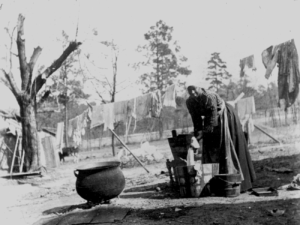
The station was close to the creek but not too close because of flooding. Water was carried from Waller Creek and deposited into several 20 gallon tubs used for soaking,scrubbing and rinsing.
Clothing was first sorted for example, into light white, heavy white, colored cotton, light wool and heavy wool. Typically, clothes were soaked for a period of time before washing to loosen the dirt. After soaking in the tub of water the clothes were scrubbed on a washboard. Then to the hot rinsing tub where the clothes were boiled to finish off the last of the vermin (lice, fleas and ticks a persistent problem), then the cold water tub before they were wrung out, usually twisted around a pole and spread on the grass or hung in trees to dry, but here on this block in Austin this option of outdoor drying was only if the clothing was colored or flannel. White wet laundry would have to be hung to dry indoors because the train passing by daily just 200ft away from the station and would have created soot from the coal fed engines.
A bit about the lye soap, which you may have heard about when washing in the old days. Lye was used everywhere wood was burned and therefore free, it just took time and talent to turn into soap.
MAKING THE SOAP WAS A SKILL
Scoop out the white ash created after a fire. Put it in a container and add water, stirring until it becomes the consistency of a thin milkshake. Set it aside for a few hours and the solids will sink to the bottom. When this happens take the liquid on top and pour it into a container, bring it to a boil and then remove from the heat, let it set and again the solids will collect on the bottom. Separate the solids from the liquids and that remaining liquid is sodium hydroxide and so alkalian that if it touches your skin it will immediately absorb all of the oil causing it to crack (keep a bottle of vinegar close by to counter attack). Cook and stir the liquid in a large flat pan until it becomes a fine powder. Lye for soap! Add the lye to water (never the other way around) because it would cause an exothermic reaction, meaning it releases heat. This causes the mixture to jump to 200 degrees in seconds, and produces deadly fumes that should not be inhaled. Then, add grease/fat (from the local butcher), stir and heat until liquid. If an egg floated in the heated mixture the lye was ready to be added to the mold which was usually a wood box. When cooled the women would cut off chunks as needed and use it to scrub clean the fabrics.