
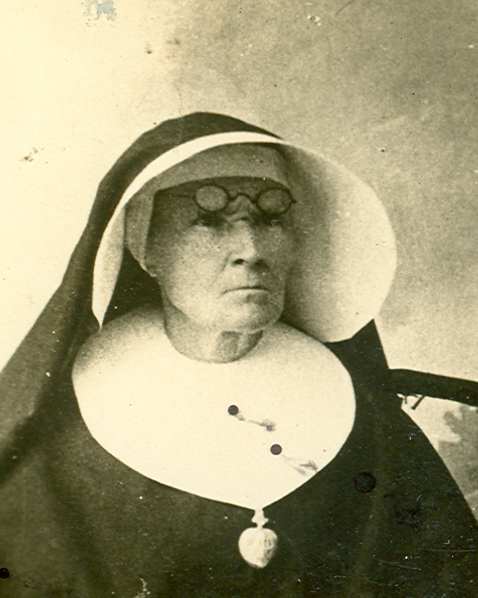
Written by Jeanine Plumer for the original Austin Ghost Tours.
In Nacogdoches, Texas, there once lived a Catholic nun.
She entered the convent as Ernestine Potard in France at the age of 24. One year later she received her habit and became Sister Mary of Saint Joseph, of the Sisters of the Holy Cross. Habit secured, in 1847, she was sent across the sea to America to work as a mission at the Convent Notre Dame in Indiana. After the Civil War, the Nacogdoches University was missing quite a few teachers. City officials contacted the Mother House in Indiana and requested a few sisters be sent to help keep the university open. Sister Mary Joseph was one of the sisters sent to Texas in 1871.
The sisters set up shop in one of the empty buildings and named their convent the Convent of the Agonizing Heart of Jesus.
One year later, the convent was moved north to Clarksville. Sister Josephine didn’t want to leave her new community and was allowed to stay. She continued teaching the predominantly Spanish, speaking children and conducting church services for 22 years. During that time she taught in a log cabin, under a tree. And in her house. The odds and the community were often against Sister Josephine. Catholicism represented old Texas, four independents, and the occasions were many when she could have left to live in a kinder environment. She stayed for her small community that would have no catechism and no sacraments if not for her instruction. She rode around on a Mustang pony and blew a cow horn when it was time for church services to begin. She died in 1893 at an Infirmary in Houston at the age of seventy one, and is buried in the little cemetery at St Edward’s University in Austin.
Catholic Nuns
A few basic garments are common nearly all female Catholic monastic orders. First there is a tunic, of a neutral color, which fits loosely and typically reaches the floor. Then, the scapular: this is an apron-like garment which covers both the front and the back. The scapular and tunic are usually tied with a belt around the waist, which, depending on the monastic order, may or may not have a rosary attached; a rosary is a set of beads which Catholics traditionally use to recite a specific set of prayers. Finally, most nuns wear a veil to cover the head; some orders of nuns additionally wear a coif, or wimple, beneath the veil to cover all their hair