
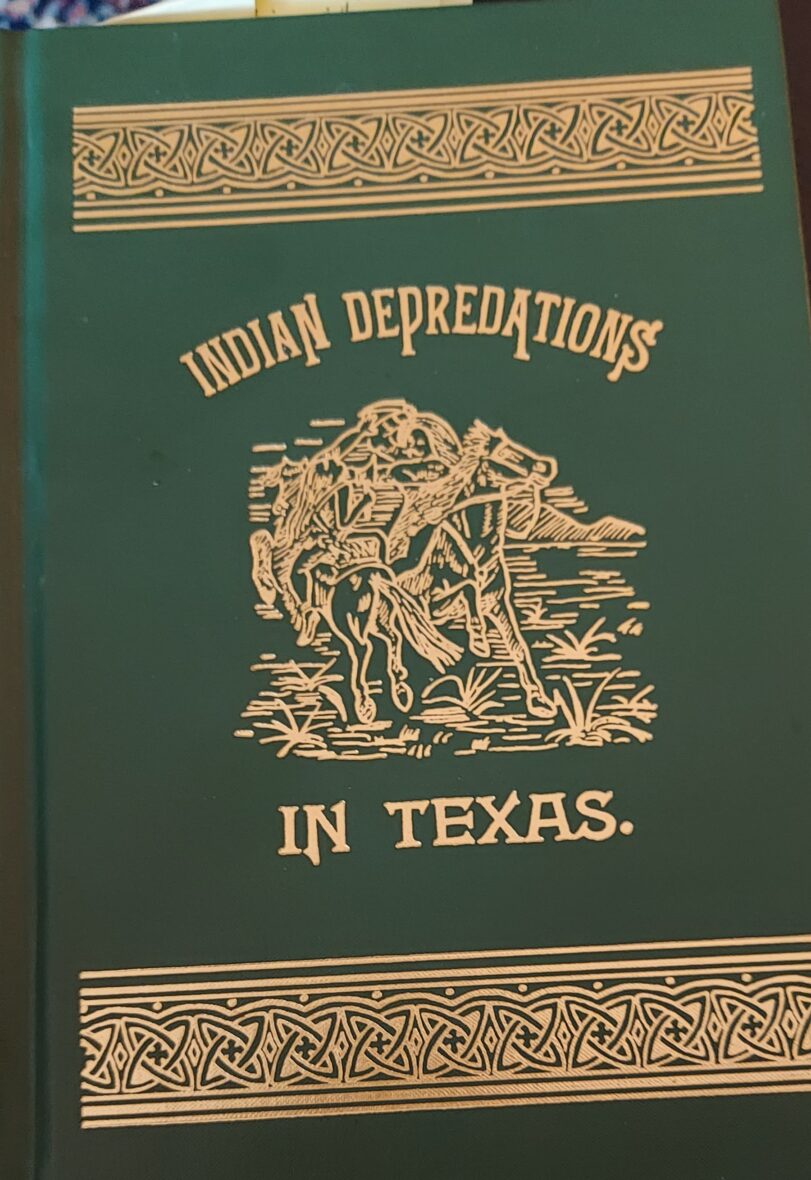
According to the book Indian Depredations in Texas.
Written by J. W Willbarger, published in, 1888.
A number of murders committed in Travis County during the year 1842. Gideon White was another who fell as a victim to the praying bands of Indians who were continuously scouring the count country around Austin. Mr White was a native of the state of Alabama and came to Texas in the winter of 1837. At which time the writer of this sketch made his acquaintance. He returned to Alabama the same winter, and in 1838 he moved his family to Texas and settled in Bastrop County, where he remained for one or two years. After the seat of government was located at Austin, Mr White moved to Travis County and settled near that city, at Seider Springs, where he lived until the time of his unfortunate death, which occurred in 1842. (this is near Seton Medical Center.)
Judge Joseph Lee and others of his friends at Austin had frequently told him that he ran great risk of losing his life. In going about the country on foot, but he paid no attention to their warnings.
One beautiful spring morning, he started out on foot in search of some stock. As he had his gun with him, And and as no Indians had been seen for some time in the vicinity of Austin, he apprehended no danger. But, as the French say, “It is the unexpected that happens”, And where you least expect to find Indians, there you are sure to meet them.
When the Indians made the attack, they were on horseback,
and had Mr White been on horseback, as he should have been, he could easily have made his escape from them. He ran for some distance, but finding the Indians were gaining on him rapidly, he sprang behind a tree, in a thicket. There he defended himself as best he could. The indigenous peoples, However, finally killed him, insight of and within 1/4 of a mile from his house.
From the number of bullet and arrow marks upon the tree behind which Mr White had taken position, it was evident that he had made a desperate resistance on to his foes. And that he succeeded in killing at least one of them before he fell, was proven by the fact that a place was found nearby where the grass was trampled down and clotted with blood.
The tree behind which Mr White fought the Indians was still standing a few years ago,
and the marks of many bullets and arrows are still plainly to be seen on the bark. The place is within two or three miles of the locality where now stands the magnificent capitol building of the state of Texas. And yet to day it is hardly probable that a single indigenous person, with the exception of a small remnant of the. CADDOES on Trinity River, could be found within the boundaries of the state. Like the Buffalo that once roamed, the broad prairies of Texas, in countless numbers, the mountains to the Gulf. Many of the indigenous peoples have disappeared forever.
In the book Austin’s Hyde Park: the First Fifty Years, 1891 through 1941 there is a chapter. It is in fact chapter one called Indians and Race Tracks. In it, the tale of Gideon White is told, but a little bit differently.
The book was published in 1991 and written by. Sarah Sitton and Thad Sitton.
Indeed, Indian attacks in the area occurred with some frequency, as many of of the early settlers discovered. In the 1840s,, Indians killed several settlers, children growing up in Hyde Park and vicinity in the early years of this century often heard family tales about Native Americans. Myrtle CUTHBERTSON heard the story of Gideon White, who was scalped at Seider Springs on Shoal Creek in the summer of 1842. As she told the story:
Well, The older boys, This, of course, was their farm where they lived, And the older boys did the plowing. And when they were plowing in the fields, there were some unfriendly Native Americans in the area at the time, and while some of the boys were plowing, others stood at the corners with guns to fight off any Indians, should any come. In fact, Gideon White, My grandfather’s first wife’s father, was scalped by Indians on Shoal Creek. The Indians were chasing him on horseback. He was on horseback and ran under a tree where grapevines were hanging down and was tangled up in one of the grapevines and knocked off his horse and Indians caught up with him and scalloped him and he died.
The Indians moved out of the Hyde Park area for good for good soon after the State Lunatic Asylum opened in March 1861 with about a dozen inmates.